Continuous and Efficient Cleaning for Production Lines. Maintain peak performance with our Inline Cleaning Equipment.
Product Description
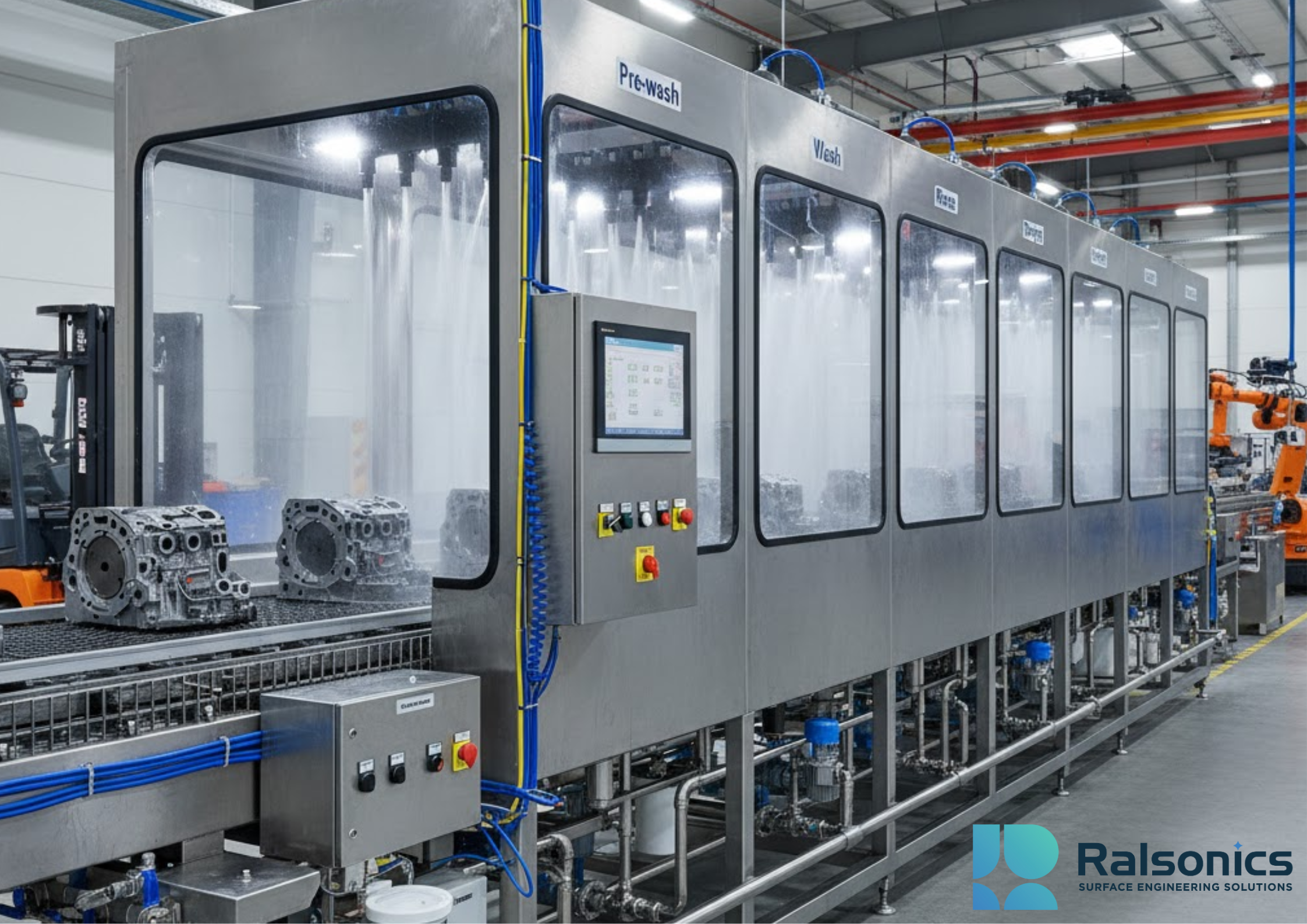
Our Inline Cleaning Equipment provides a high-efficiency solution for continuous cleaning in production lines. Designed to seamlessly integrate with existing manufacturing processes, this equipment ensures thorough and consistent cleaning of components as they move through the production line. Its advanced features and robust construction make it an essential tool for maintaining cleanliness and quality in various industrial applications.
Ralsonics Inline Ultrasonic Cleaning Systems are designed for continuous, high-volume industrial cleaning applications. Unlike batch or manual systems, inline ultrasonic cleaners integrate ultrasonic cleaning, rinsing, and drying directly into the production line. This ensures faster throughput, consistent results, and minimal manual handling, making them ideal for industries with demanding cleanliness standards.
By combining advanced ultrasonic cavitation technology with automated material handling, these systems deliver precise and repeatable cleaning performance while reducing labor costs and improving production efficiency.
When to Use This?
How It Works?
Key Features
Advantages
Industry Application
Features and Advantages
| Features | Advantage | |
|---|---|---|
| Standard Features | Continuous Operation | Provides uninterrupted cleaning, integrated with production lines. |
| High-Pressure Washing | Ensures thorough removal of residues and contaminants. | |
| Durable Stainless Steel Construction | Provides long-lasting performance and resistance to corrosion. | |
| User-Friendly Control Panel | Allows easy operation and precise control of cleaning parameters. | |
| Digital Timer | Ensures consistent and repeatable cleaning cycles. | |
| Digital Temperature Control | Precisely controls water temperature for optimal cleaning results. | |
| Adjustable Spray Nozzles | Provides effective cleaning for different part sizes and shapes. | |
| Integrated Filtration System | Continuous removal of contaminants from the cleaning solution. | |
| Additional Features | Programmable Control | Allows for detailed customization of cleaning parameters. |
| Modular Design | Easily scalable for different production volumes and requirements. | |
| Energy Efficient Design | Reduces operational costs through lower energy consumption. | |
| Safety Features | Safety Interlocks | Automatically shuts down in case of malfunctions, ensuring operator safety. |
| Emergency Shutdown Buttons | Provides immediate stoppage in case of emergencies. | |
| Guarding and Enclosures | Protects operators from moving parts and potential hazards. | |
| Temperature Control | Prevents overheating and ensures safe operating conditions. |
“FAQs”
Q1. What is an inline ultrasonic cleaning system?
It is a continuous cleaning system where parts move automatically through ultrasonic cleaning, rinsing, and drying stages, eliminating manual transfers.
Q2. How is it different from a multistage manual system?
Unlike manual systems, inline systems are fully automated, ensuring higher throughput, consistency, and reduced labor costs.
Q3. Can inline ultrasonic cleaning handle delicate components?
Yes. With higher frequencies (40–80 kHz), it safely cleans delicate items such as PCBs, optical lenses, and medical instruments.
Q4. How energy-efficient is the system?
Inline ultrasonic cleaners use water recycling, efficient heating, and controlled ultrasonic power, reducing overall energy and chemical consumption.