Product Description
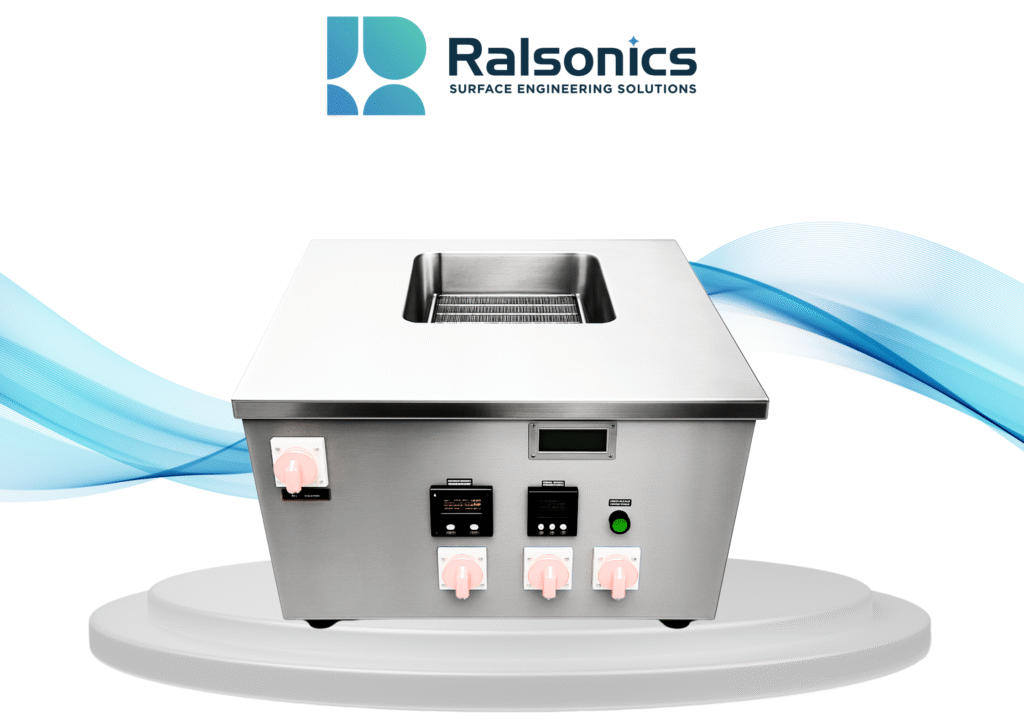
Ralsonics’ compact ultrasonic cleaners are designed for small items in small batches. They remove contamination from complicated parts which are hard to access by manual cleaning with damage. They can also be used for degassing solvents and dispersing solid samples. Being relatively inexpensive and compact, they are ideal for professional maintenance cleaning.
An Ultrasonic Bath Sonicator is a compact yet powerful cleaning and processing device that uses high-frequency ultrasonic waves to create intense cavitation in a liquid medium. This cavitation dislodges contaminants from surfaces, mixes solutions, and facilitates various laboratory processes.
Ralsonics’ Ultrasonic Bath Sonicators are engineered for precision, reliability, and versatility, making them ideal for laboratories, research institutes, medical facilities, electronics workshops, and industrial cleaning applications.
Contact our experts for more details.
How an Ultrasonic Bath Sonicator Works
Key Features
Advantages
Application
When to use this?
Economical hands free cleaning requirement
Small items and occasional cleaning
Standard Models
| Model No. | Ultrasonic Power (W) | Tank Size Internal (L X B X H) (mm) |
Tank Volume (Liters) |
|---|---|---|---|
| RCC-100 | 100 | 300 * 151 * 150 | 5.7 |
| RCC-200 | 200 | 300 * 240 * 200 | 12.5 |
| RCC-300 | 300 | 505 * 300 * 150 | 19 |
| RCC-500 | 500 | 505 * 300 * 200 | 28 |
Features
Stainless steel tanks
Cavitation resistant long life tanks
Ultrasonic Cleaning
Clean inaccessible areas easily
Digital Timer
Set and control the process time
Stainless Steel Covers
Longer lasting equipment
Optional Features
Multi-frequency Ultrasonics
Handle different types of contamination
Ultrasonic Sweep
Higher efficiency of cleaning
“FAQs”
Q1. What is the difference between an ultrasonic cleaner and an ultrasonic bath sonicator?
An ultrasonic cleaner is primarily used for cleaning, while an ultrasonic bath sonicator is designed for both cleaning and laboratory applications such as mixing, dispersing, and homogenization.
Q2. Can biological samples be processed with a sonicator bath?
Yes. It can be used for cell disruption, DNA/RNA extraction, and enzyme activation in research labs.
Q3. Is temperature control important in ultrasonic baths?
Yes. Precise temperature regulation ensures consistent cleaning and prevents damage to delicate samples.
Q4. Can it be used continuously for long durations?
Yes, but usage depends on the power rating and cooling system. Industrial-grade sonicators support extended use.